
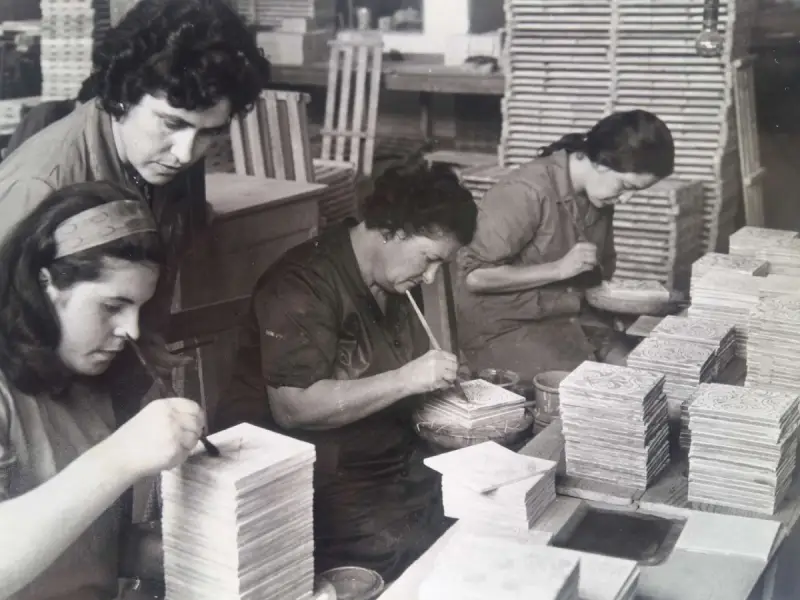
Porto is a paradise for those looking for Portuguese tiles and ceramics — but it is also one of the places where tradition is most easily confused with mass production. Knowing how to distinguish between an authentic piece and a simple tourist souvenir makes all the difference: not only in quality, but in the story you take home with you.
Imperfection is a sign of authenticity
One of the most striking characteristics of real Portuguese ceramics is what many call “intentional imperfection.” Slightly irregular shapes, subtle color variations, and details that are not perfectly symmetrical are not flaws — they are proof of a handmade, human process.
In hand-painted pieces, you can see the artist’s gesture in the brushstroke: small differences in the line and in the intensity of the blue or other colors show that the piece did not come from an industrial production line.
The glaze and colors are never identical
Reactive glazes, very common in Portuguese production, create gradients and unique effects. This means that no two pieces are exactly the same — one of the biggest contrasts with mass-produced products, where everything is uniform.
Looking at the back of the tile tells a story
Turning a tile around can reveal more than its front:
- Rougher surfaces indicate traditional methods
- Marks, stamps, or factory names help identify the origin
- Signs of time are common in antique and reclaimed pieces
.
This is precisely where the difference between a generic shop and a specialized store becomes clear.
Authenticity you can prove
In our store we work directly with authentic Portuguese tiles — both from historical factories and from current production. They are the very same tiles you see on the buildings of Porto and other cities across the country.
Many of them still have the factory name carved on the back, which allows their origin to be verified and connects each piece to a real chapter of the Portuguese ceramic industry.
Local production, living tradition
Portugal has centuries of ceramic tradition, with factories and workshops where knowledge is passed from generation to generation. Even when semi-industrial processes exist, much of the finishing is still done by hand — from smoothing to glazing.
Buying an authentic piece means taking home this cultural continuity, not just a decorative object.
How to avoid tourist traps
Before buying, ask:
- Is the piece hand-painted?
- Is there variation between similar pieces?
- Is the origin identifiable?
- Does the seller know the factory or the production process?
.
If the answer is yes, you are likely looking at something genuine.
Take home a real piece of Portugal
Among so many tourist-oriented shops, choosing authentic ceramics means choosing history, identity, and local production. It means taking home a true fragment of Portuguese architecture and culture — not just a souvenir.